
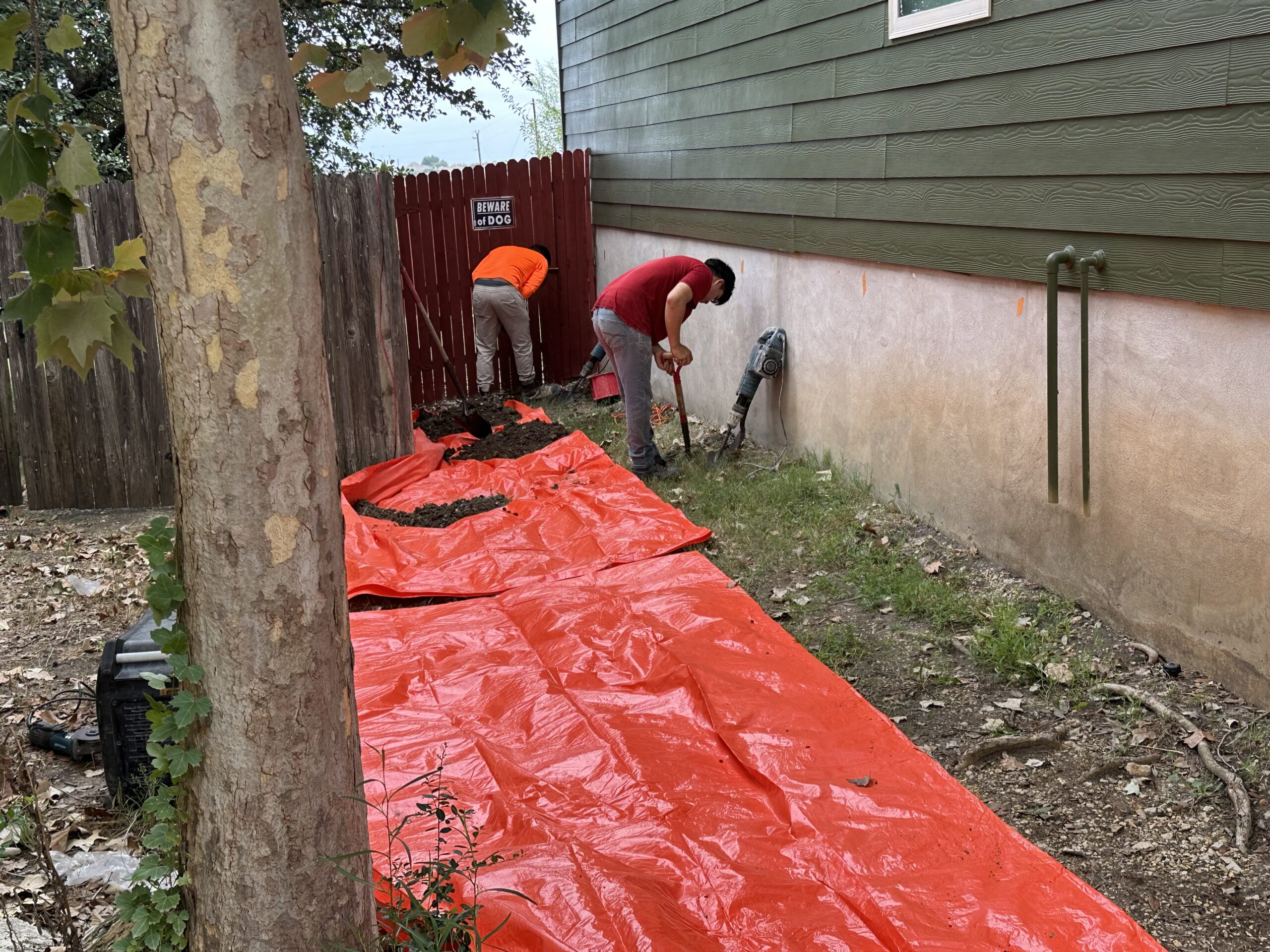
Poor drainage can create moisture conditions that deserve attention around a foundation. Water collecting beside a home is a reason to evaluate the site, not automatic proof that the house needs piers. A useful plan considers both where water comes from and where it can safely go.
Watch what happens during ordinary rainfall
From a safe location, note where rainfall collects and whether surface water becomes trapped in a confined side yard. Take photographs showing the wider area as well as the puddle. A close-up alone may not explain how water reached the spot.
Avoid entering flowing water or opening drainage structures during a storm. Your goal is to collect useful observations, not to perform excavation or repairs in unsafe conditions.
Start with the whole water path
The U.S. Department of Energy’s Building America guidance emphasizes moving water away from a home through coordinated grading and drainage. Depending on site constraints, that can involve grading improvements, swales, or drains. The choice depends on the property rather than a single product name.
Ask the evaluator to explain the source, collection point, route, and proposed discharge location. An estimate that lists a drain without identifying its outlet leaves an important question unanswered.
Why a French drain is not always the answer
Different drainage systems collect water in different ways. Before choosing one, ask what type of water problem is being addressed and why the proposed approach fits it. Installation details, access for maintenance, and the available discharge route should be part of that discussion.
Do not assume that adding soil against the building or digging beside it is a harmless experiment. Existing clearances, utilities, and the foundation itself need to be considered before altering the site.
Does fixing drainage repair existing damage?
Drainage work and structural repair serve different purposes. Ask whether water management is the primary recommendation, part of a larger repair plan, or a maintenance measure. Existing cracks and floor changes still need their own interpretation. A promise that one drain will solve every symptom should prompt further questions.
What to ask before approving work
- What observations support this recommendation?
- Where will the collected water discharge?
- How will the work affect neighboring property and existing utilities?
- What maintenance will the system require?
- What is included in restoration and cleanup?
Arrange a local drainage evaluation
Explore X-Treme Steel’s drainage solutions and contact our office to discuss your property. Call (210) 864-9911. If you are also seeing foundation symptoms, mention them when scheduling.
Further reading: Building America Solution Center: Final Grade Slopes Away from Foundation.